


Tuber Mesentericum
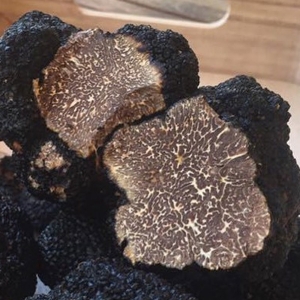
Tuber mesentericum, the black truffle of Lorraine, is an edible species that appears a few centimeters below the surface of the soil, in shady places and in lime-rich soils. The aroma of Tuber mesentericum is very intense, reminiscent of phenol or iodine and weakens when exposed to air. The taste of Tuber mesentericum is special, intense and reminiscent of almond. It is considered by some to be similar to Tuber aestivum but stands out from the strong phenol taste.


Tuber Melanosporum
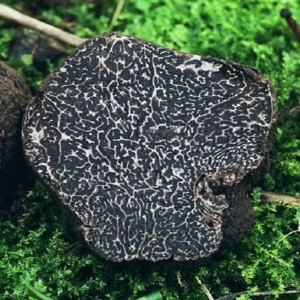
Tuber melanosporum, called the black truffle, Périgord truffle or French black truffle, is a species of truffle native to Southern Europe. It is one of the most expensive edible mushrooms in the world.
The round, dark brown fruiting bodies (ascocarps) have a black-brown skin with small pyramidal cusps. They have a strong, aromatic smell and normally reach a size of up to 10 cm. Some may be significantly larger, such as a black truffle found 2012 in Dordogne with a mass of 1.277 kg.
Their flesh is initially white, then dark. It is permeated by white veins which turn brown with age. The spores are elliptical and measure about 22–55 µm by 20–35 µm. They are dark brown and covered with large spikes.
Aroma
The fruiting bodies of the black truffle exude a scent reminiscent of undergrowth, strawberries, wet earth or dried fruit with a hint of cocoa. Their taste, which fully develops after the truffles are heated, is slightly peppery and bitter. If stored at room temperature, the aromatic compounds dissipate, while storage at around the freezing point (0 °C) leads to an increased synthesis of these compounds.
The volatile compounds that contribute to the aroma and are developed by the fruiting bodies include 2-methyl-1-butanol, isoamyl alcohol, 2-methylbutyraldehyde and 3-methylbutyraldehyde, as well as traces of sulfur compounds. One of these, dimethyl sulfide, is what attracts truffle dogs, truffle hogs and truffle flies to the fruiting bodies. Several species of yeast, which produce part of the aromatic compounds, have been isolated from Tuber melanosporum and Tuber magnatum.


Tuber Magnatum
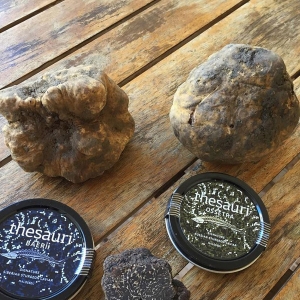
The Tuber magnatum or White Precious Truffle requires fertile soils, at an altitude of 200-450 m. Its harvest is done in autumn, several centimeters below the ground, in broadleaf forests mainly oak or hazelnut. It is definitely the most expensive truffle because of the rarity and difficulty of finding it, since it is the only species that is not cultivated, but also the soils where it is encountered are very specific and rare.
It is irregular in shape, lobed, with small grooves, diameter usually 2-6 cm. It has smooth skin and color pale yellow, ocher, beige and sometimes greenish-yellowish.
Its flesh is initially white and has a strong odor that resembles a mixture of garlic and cheese, with an intense and pleasant taste of garlic.
In the kitchen is perfectly combined with fish, risotto, pasta, eggs, light poultry meat, beef and cheese sauces.


Tuber Brumale
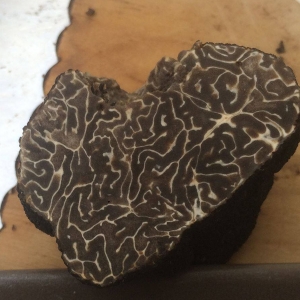
The Tuber brumale fructify at an altitude of 200-1000 meters, underground at a depth of 5- 30 cm, on limestone soils and broadleaved forests, mainly hazelnut and lime. The harvest begins on November and ends on March. A variety of truffle widespread in France and Italy, and the Balkans. It usually has the size of a walnut, 1-5 cm and a weight of 30-100 gr, its shape is irregular spherical, sometimes with a flat base, with pyramidal projections, smaller than the Tuber melanosporum, bearing faces 5-6 and tear away easily. Its color is black, sometimes reddish at the base.
The flesh is initially off-white, and gray-blackish in maturity, with thick but sparse branches that do not change color when exposed to air. It has a strong and pleasant aroma reminiscent of wood.


Tuber Borchii
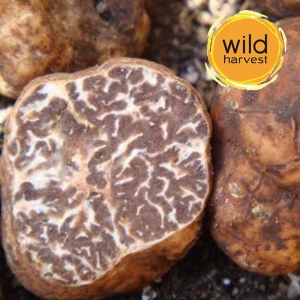
The Tuber Borchii is white truffle and is harvested from the month of February until April. Adds culinary value and flavor to dishes typically from the white meat fish combined with white wine, Giving luxury and one special touch to your dish. Combined with white sauces such as beurre blanc sauce and fish.
Fruition: February - March

Tuber Aestivum
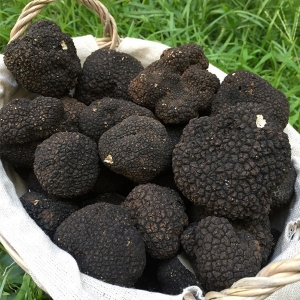
The summer truffle (Tuber aestivum) or burgundy truffle (Tuber uncinatum) is a species of truffle, found in almost all European countries.The flavor, size and color of summer truffles (Italian: tartufo estivo) is similar to that of burgundy truffles, but their aroma is less intense and the flesh (gleba) is a paler hazel color.
As their name suggests, summer truffles are harvested earlier than burgundy truffles, from May to August. They are most often found in the southern part of the distribution area of the species, notably in the Mediterranean climate areas of France, Italy and Spain.
Fruition: March - August


Black tuber Oregon
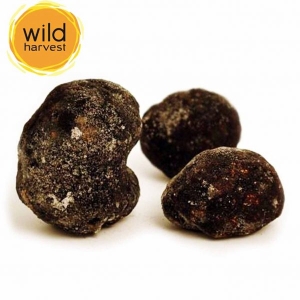
The Black Oregon Truffle (Leucangium carthusianum) have a strong spicy, fruity and intense flavor, like apples and pineapples. The texture can be compared to a hard grated or ground almonds. The flavor is less important than the aroma that is fragrant.
Presented in Greek territories from early December until late April. Store fresh truffles in the refrigerator immersed in a container of uncooked rice or wrapped loosely in paper towels. The fresh truffles are best when used within a week or less after arrival.
Lactarius sp
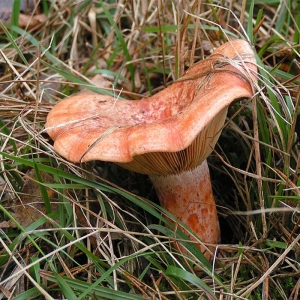
Lactarius deliciosus, commonly known as the saffron milk cap and red pine mushroom, is one of the best known members of the large milk-cap genus Lactarius in the order Russulales. It is found in Europe and has been accidentally introduced to other countries under conifers and can be found growing in pine plantations. A fresco in the Roman town of Herculaneum appears to depict Lactarius deliciosus and is one of the earliest pieces of art to illustrate a fungus.
Lactarius deliciosus has a carrot orange cap that is convex to vase shaped, inrolled when young, 4 to 14 cm (1.5 to 5.5 in) across, often with darker orange lines in the form of concentric circles. The cap is sticky and viscid when wet, but is often dry. It has crowded decurrent gills and a squat orange stipe that is often hollow, 3 to 8 cm (1 to 3 in) long and 1 to 2 cm (0.5 to 1 in) thick. This mushroom stains a deep green color when handled. When fresh, the mushroom exudes an orange-red latex or "milk" that does not change color.


Lactarius sp
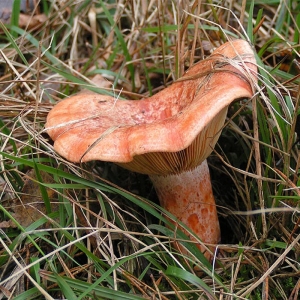
Lactarius deliciosus, commonly known as the saffron milk cap and red pine mushroom, is one of the best known members of the large milk-cap genus Lactarius in the order Russulales. It is found in Europe and has been accidentally introduced to other countries under conifers and can be found growing in pine plantations. A fresco in the Roman town of Herculaneum appears to depict Lactarius deliciosus and is one of the earliest pieces of art to illustrate a fungus.
Lactarius deliciosus has a carrot orange cap that is convex to vase shaped, inrolled when young, 4 to 14 cm (1.5 to 5.5 in) across, often with darker orange lines in the form of concentric circles. The cap is sticky and viscid when wet, but is often dry. It has crowded decurrent gills and a squat orange stipe that is often hollow, 3 to 8 cm (1 to 3 in) long and 1 to 2 cm (0.5 to 1 in) thick. This mushroom stains a deep green color when handled. When fresh, the mushroom exudes an orange-red latex or "milk" that does not change color.
Agaricus sp
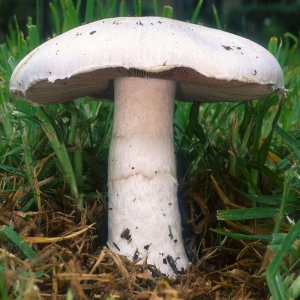
Agaricus is a genus of mushrooms containing both edible and poisonous species, with possibly over 300 members worldwide. The genus contains the most widely consumed and best-known mushroom today, A. bisporus, with A. campestris also being well known.
Members of Agaricus are characterized by having a fleshy cap or pileus, from the underside of which grow a number of radiating plates or gills on which are produced the naked spores. They are distinguished from other members of their family, Agaricaceae, by their chocolate-brown spores. Members of Agaricus also have a stem or stipe, which elevates it above the object on which the mushroom grows, or substrate, and a partial veil, which protects the developing gills and later forms a ring or annulus on the stalk.


